★5.0 ratingSan Leandro Sub-Zero customersLocal focusSub-Zero built-ins in 94577, 94578 and 94579IndependentSub-Zero & Wolf specialists since 2005
technical | San Leandro, Alameda County
Sub-Zero alarms need model proof, not a copied code chart
In San Leandro, a Sub-Zero alarm is read by model and serial, never matched to a generic code chart. A flashing “Service” indicator, a “Vacuum Condenser” reminder, or a high-temperature alarm can follow a packed condenser, a Heron Bay door-seal leak, an evaporator fan, or a thermistor fault. Photograph the display and verify the code before approving a control board.
What does a Sub-Zero high-temperature alarm mean in Bay-O-Vista, San Leandro?
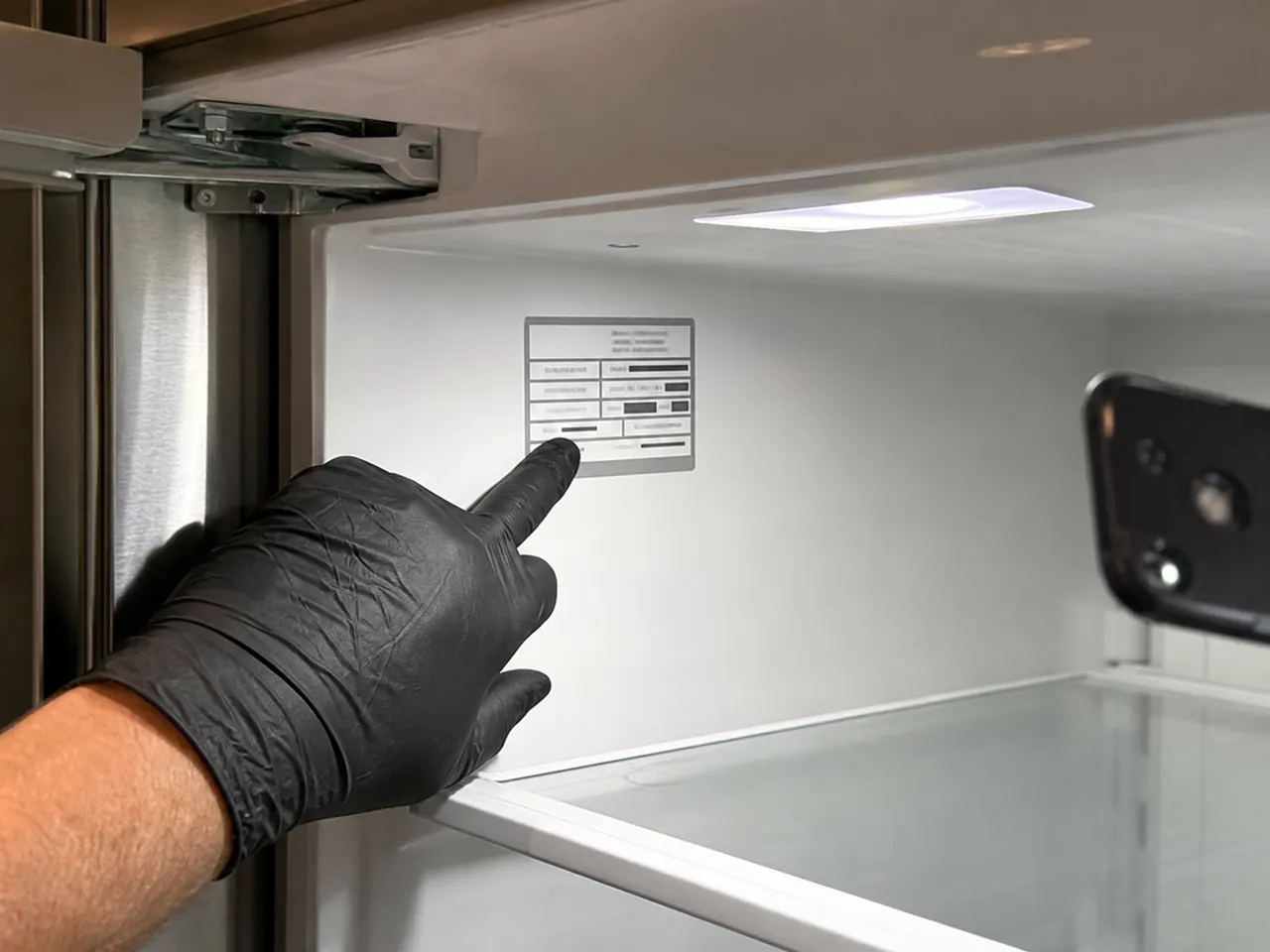
San Leandro Sub-Zero Repair reads the model and serial first, because a high-temperature alarm in Bay-O-Vista (94578) can follow a blocked condenser, a thermistor fault or a failed fan rather than a control board. We photograph the display, compare actual temperatures and skip copied code charts. Ready to verify your alarm? Dial 510-390-9712 to schedule.
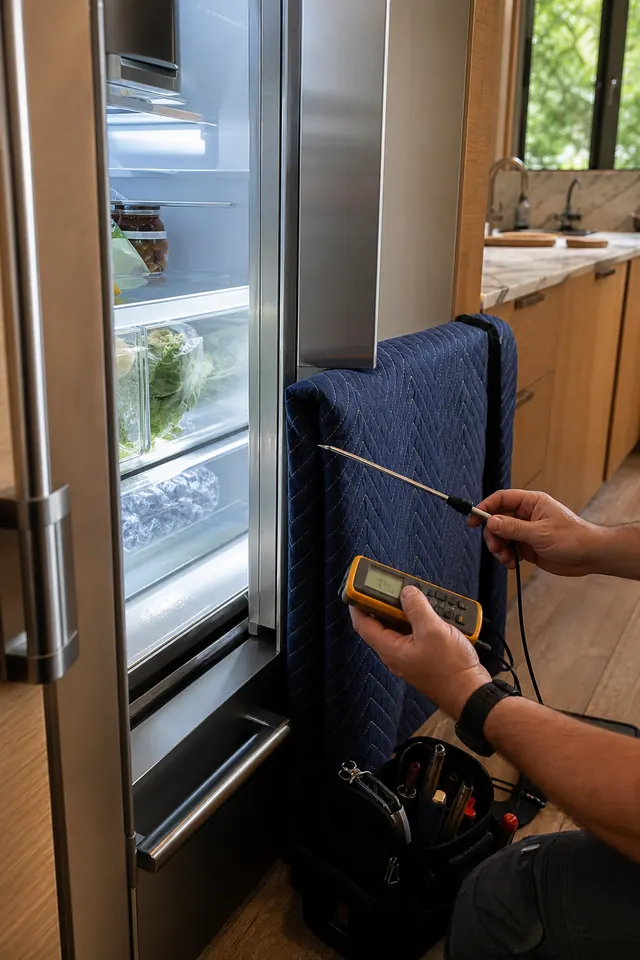
Temperature reading being taken on a built-in refrigerator during alarm diagnosis
Quick reference
Sub-Zero error codes & alarms list (San Leandro)
A plain-language list of the Sub-Zero alarms and display behaviors we see most in San Leandro kitchens. It is a reasoning aid, not a code dictionary — exact codes are read by model and serial, so confirm yours on the rating plate before acting.
Alarm / display behavior
What it usually points to
What to do
Flashing or solid “Service” indicator
A stored fault, sensor input or board condition; the meaning varies by model family.
Photograph it, leave power on, and verify against your model and serial before any reset.
“Vacuum Condenser” reminder or unusually long run times
Condenser coil packed with dust, lint or pet hair, restricting airflow.
Pull the lower grille, check the condenser, and re-probe cycling after a clean.
Frost line or condensation at the door edge
Door gasket leak or seal swelling, common where Heron Bay marine moisture and bay salt air work the seals.
Run a paper-drag seal test; OEM gasket or a hinge and panel-reveal adjustment.
Over-temp / high-temp alarm after a long door-open
Normal recovery, or a marginal temperature sensor.
Allow a full recovery cycle, then re-probe before replacing a thermistor.
Fresh-food warm while the freezer still holds
Evaporator fan, frosted coil or air damper, not necessarily the sealed system.
Watch fan rotation and airflow; defrost, fan or damper repair as measured.
Blank, frozen or unresponsive display
Control board, ribbon connector or power supply.
Confirm supply voltage; reseat or replace the confirmed board, and avoid repeated power-cycling.
Newer Sub-Zero models may show an EC-style electronic code; the meaning is model-specific, so read it against your model and serial rather than a generic chart. Numbers are not universal, so do not order a part from an online list alone.
Direct answer
Direct answers for San Leandro Sub-Zero owners
Clear, direct answers to the questions San Leandro Sub-Zero owners ask most.
Sub-Zero alarms need model proof, not a copied code chart
A Sub-Zero alarm on a Castro Valley route visit can point toward sealed-system suspicion that needs EPA-certified verification, but the display alone is not enough to price that repair. Error meanings vary by model family, software version and sensor layout. In San Leandro, a high-temperature alarm may follow a blocked condenser, a door seal leak, a failed fan, or a thermistor issue. We verify by model and serial before assigning a control board, sensor, or sealed-system path.
Model and serial details, two temperature readings, lower-grille or water-line notes, the neighborhood and a short symptom timeline should be ready before approving parts.
Diagnostic visits are $145-$225; common gasket, water-side, fan and sensor repairs often take 1-3 hours; sealed-system work requires proof and may take 2-6 hours plus parts lead time.
What San Leandro homeowners say about our Sub-Zero service
Real feedback from local Sub-Zero built-in refrigeration customers across San Leandro neighborhoods.
*****
Our Washington Manor-Bonaire Sub-Zero kept showing a high-temperature alarm after resets. They photographed the display, measured 46°F fresh food, tested the thermistor and found a failed fan circuit. The $690 repair took 2.5 hours and the alarm stopped.
S.O., Washington Manor-BonaireWashington Manor-Bonaire, San Leandro
*****
In Heron Bay, an alarm followed foggy mornings and door sweat. The tech checked actual temperatures, gasket contact and condenser heat before touching controls. It was a $410 airflow and seal correction, not the $1,000 board another chart suggested.
Homeowner, Heron BayHeron Bay, San Leandro
*****
Our Bay-O-Vista display code looked scary, but they matched it to the exact model and serial. Sensor readings were out of range, so the repair was a $520 thermistor path in 90 minutes. The freezer stayed at 0°F afterward.
P.A., Bay-O-VistaBay-O-Vista, San Leandro
San Leandro evidence facts
What makes this diagnosis local
Sub-Zero alarm diagnosis in San Leandro starts at $145-$225 with display photo, actual temperatures, model tag and reset timeline.
A copied code chart is weak evidence unless the exact model, serial range and actual temperature behavior match.
Repeated high-temperature alarms are urgent when fresh food is above 45°F or freezer is above 15°F after doors stay closed.
A board path can cost $620-$1,180, so airflow, sensor values and fan response should be proven before replacement.
Heron Bay door sweat and Bay-O-Vista heat can create alarm symptoms that look electronic but start as cabinet or airflow problems.
Published ranges
San Leandro Sub-Zero repair cost table
These are planning ranges only. A final quote still depends on model, part availability, cabinet access and diagnosis.
Service / symptom
What includes
Price range
Time
Alarm and temperature diagnostic
Display photo, actual readings, model/serial proof and reset timeline.
$145-$225
50-95 min
Thermistor or sensor circuit repair
Sensor values, harness checks, model-specific part match and recovery verification.
$345-$920
1-3 hours
Control board proof and replacement path
Board output checks, fan/compressor commands, error history and part availability.
$620-$1,180
2-4 hours
High-temperature alarm with airflow fault
Condenser cleaning, fan response, door seal check and independent temperature retest.
$285-$820
1-3 hours
Alarm supporting sealed-system testing
Electrical, frost-pattern and pressure-side evidence before compressor economics.
$1,425-$3,380
2-6 hours plus parts
Final San Leandro pricing depends most on model family, part availability, actual temperatures and cabinet access, with Heron Bay moisture and Bay-O-Vista access often changing the time window.
Diagnostic counter
Sub-Zero alarms need model proof, not a copied code chart evidence matrix
The first visit should separate cabinet, airflow, water-side, control and sealed-system evidence. The table gives a practical starting point, not a universal code chart.
Symptom or branch
Safe first check
Technician evidence
Urgency
High temperature alarm
Compare display reading to an independent thermometer and inspect door seal and airflow.
Actual temperatures, model tag, condenser airflow, door contact, fan response and cabinet access notes.
Same-day if paired with warming; otherwise next available diagnostic.
Service or EC-style message
Verify exact model family and do not assume one code chart applies to every Sub-Zero.
Actual temperatures, model tag, condenser airflow, door contact, fan response and cabinet access notes.
Same-day if paired with warming; otherwise next available diagnostic.
Repeated alarm after reset
Check sensor values, fan response, condenser loading and control output while the symptom is active.
Actual temperatures, model tag, condenser airflow, door contact, fan response and cabinet access notes.
Same-day if paired with warming; otherwise next available diagnostic.
Moisture and access matrix
Neighborhood conditions that change the visit
Neighborhood
Condition
Service implication
Estudillo Estates-Glen / 94577
Older homes, custom openings and trim that may not tolerate rushed cabinet movement.
Confirm model tag, cabinet reveal, door swing and condenser access before quoting sealed-system work. For alarm and sensor interpretation, record model family, actual temperatures and access risk before parts.
Broadmoor District
Older kitchen updates and built-ins fitted into painted face frames.
Separate cabinet heat and door alignment issues from refrigeration failure. For alarm and sensor interpretation, record model family, actual temperatures and access risk before parts.
Mulford Gardens
Bay air, water-line routing and practical family kitchens with heavy door use.
Inspect gasket compression, lower grille loading and water-side restrictions. For alarm and sensor interpretation, record model family, actual temperatures and access risk before parts.
Washington Manor-Bonaire
Busy remodels, flooring changes and panel weight on older built-ins.
Check leveling, hinge sag, drawer rail closure and safe access before parts are ordered. For alarm and sensor interpretation, record model family, actual temperatures and access risk before parts.
Heron Bay / 94579
Bay-side moisture, newer integrated cabinets and slower ice recovery.
Check gasket contact, water path, freezer temperature and condenser airflow before replacing ice maker parts. For alarm and sensor interpretation, record model family, actual temperatures and access risk before parts.
Bay-O-Vista / 94578
Hillside access, sun exposure, tight remodels and pull-out constraints.
Plan front-access diagnosis first and document floor, panel and water-line risk before moving a built-in. For alarm and sensor interpretation, record model family, actual temperatures and access risk before parts.
Local install reality
Why San Leandro changes the repair path
San Lorenzo and Hayward route overlap helps with scheduling, but alarms still need appliance-specific evidence. A waterfront cabinet with poor ventilation can trigger a high-temp complaint that looks electronic, while a hillside kitchen may have a door panel alignment issue that keeps the alarm returning. The service visit should include actual temperatures, door contact, fan response, condenser condition and board output checks. Any code meaning that is not confirmed by model gets treated as a clue, not a final diagnosis.
Humidity, salt air, fog cycles, gasket swelling, condenser corrosion and tight waterfront cabinetry are not abstract here. They change which evidence matters first and whether a Sub-Zero repair can be completed from the front without disturbing the cabinet.
Model and access details are checked before parts are ordered.
Diagnostic scenarios
How common San Leandro Sub-Zero calls are handled
Typical diagnostic patterns we see on built-in Sub-Zero refrigeration across San Leandro neighborhoods.
Estudillo Estates-Glen / 94577 alarm and sensor interpretation scenario
Model family: 600/700 series. Symptom: High temperature alarm. Tests: Compare display reading to an independent thermometer and inspect door seal and airflow. Technician evidence: Actual temperatures, model tag, condenser airflow, door contact, fan response and cabinet access notes. Outcome: Alarm and temperature diagnostic stays in the $145-$225 planning range when evidence matches. Time: 50-95 min.
Broadmoor District alarm and sensor interpretation scenario
Model family: wine column. Symptom: Service or EC-style message. Tests: Verify exact model family and do not assume one code chart applies to every Sub-Zero. Technician evidence: Actual temperatures, model tag, condenser airflow, door contact, fan response and cabinet access notes. Outcome: Thermistor or sensor circuit repair stays in the $345-$920 planning range when evidence matches. Time: 1-3 hours.
Mulford Gardens alarm and sensor interpretation scenario
Model family: drawer freezer. Symptom: Repeated alarm after reset. Tests: Check sensor values, fan response, condenser loading and control output while the symptom is active. Technician evidence: Actual temperatures, model tag, condenser airflow, door contact, fan response and cabinet access notes. Outcome: Control board proof and replacement path stays in the $620-$1,180 planning range when evidence matches. Time: 2-4 hours.
Sequence
How the diagnostic visit is structured
We do not guess sealed systems, control boards or cabinet pull-outs from a headline symptom. The sequence below keeps the repair tied to proof.
1Capture the alarm
The display, time, actual temperatures and reset history are photographed before the message is cleared.
2Match model and serial
The exact Sub-Zero family decides which alarm path is relevant and which copied charts are ignored.
3Compare actual temperature
Independent readings decide whether the alarm is food-safety urgent or a nuisance/control clue.
4Test the supporting branch
Sensor values, fan response, condenser airflow, gasket contact and board output are checked against the alarm.
5Quote from evidence
Control, sensor, airflow or sealed-system pricing is assigned only when the measured branch supports it.
Before the appointment
What to have ready and what not to reset
Have the model and serial details nearby if they are requested during the call or external online booking step.
Do not reset the breaker, clear an alarm, or unplug the unit right before diagnosis unless food safety requires it; fresh readings help identify the failure path.
Clear the lower grille, toe-kick, and first two feet around the cabinet so airflow, water connections, and door alignment can be checked without scraping millwork.
Visible FAQ
Answers before you book
Can you diagnose an alarm over the phone?
A call can narrow the likely branch if the model family, displayed message and actual temperature are ready. We cannot honestly quote a control board or sealed-system repair from an alarm alone.
Should I reset the alarm?
If food safety is not at risk, take photos first and note the temperature. Clearing the message can remove useful timing evidence for the visit.
Are Sub-Zero codes universal?
No. Code behavior and service-mode values vary by series. We use the model and serial to verify the correct reference path instead of publishing made-up exact values.
What is the expensive alarm scenario?
The expensive branch is a supported sealed-system diagnosis, but that requires temperature behavior, frost pattern and electrical checks. A dirty condenser or failed fan can create similar symptoms.
Should I clear a Sub-Zero alarm before service?
Take a photo first if food safety allows. The displayed message, actual temperature and time since the last reset help separate sensor, fan, door and control branches. Clearing a recurring high-temperature alarm can hide the evidence needed for the $145-$225 diagnostic to be useful.
Why are copied Sub-Zero code charts risky?
Sub-Zero error behavior changes by series and serial range. A copied chart can send a San Leandro owner toward a $620-$1,180 control board when the real issue is airflow, gasket contact or condenser heat. The model tag and actual temperature must anchor any alarm interpretation.
After the proof, not before it
Call or book an alarm diagnostic
For active cooling loss, call first. For stable symptoms, use the online booking page to request a diagnostic window.