★5.0 ratingSan Leandro Sub-Zero customersLocal focusSub-Zero built-ins in 94577, 94578 and 94579IndependentSub-Zero & Wolf specialists since 2005
symptom | San Leandro, Alameda County
Sub-Zero not cooling in San Leandro: what to check before the expensive answer
If a Sub-Zero near Casa Peralta is not cooling and you also see a door gasket leak, condensation, or a frost line, the failure path may be air infiltration rather than a dead compressor. San Leandro humidity and tight cabinetry can make a warm fresh-food section look dramatic, especially when the freezer still holds. A useful diagnosis starts with actual temperatures, condenser airflow, fan operation, gasket contact and frost pattern. That order protects you from paying for the most expensive repair before the basic evidence is in.
Why is my Sub-Zero not cooling in Estudillo Estates-Glen, San Leandro?
San Leandro Sub-Zero Repair records fresh-food and freezer temperatures, then checks condenser airflow, the evaporator fan, gasket contact and frost pattern before anyone mentions a compressor. In Estudillo Estates-Glen (94577) a warm fresh-food side with a cold freezer usually points to a fan or air path. Losing cold now? Phone 510-390-9712 for a same-day diagnostic.
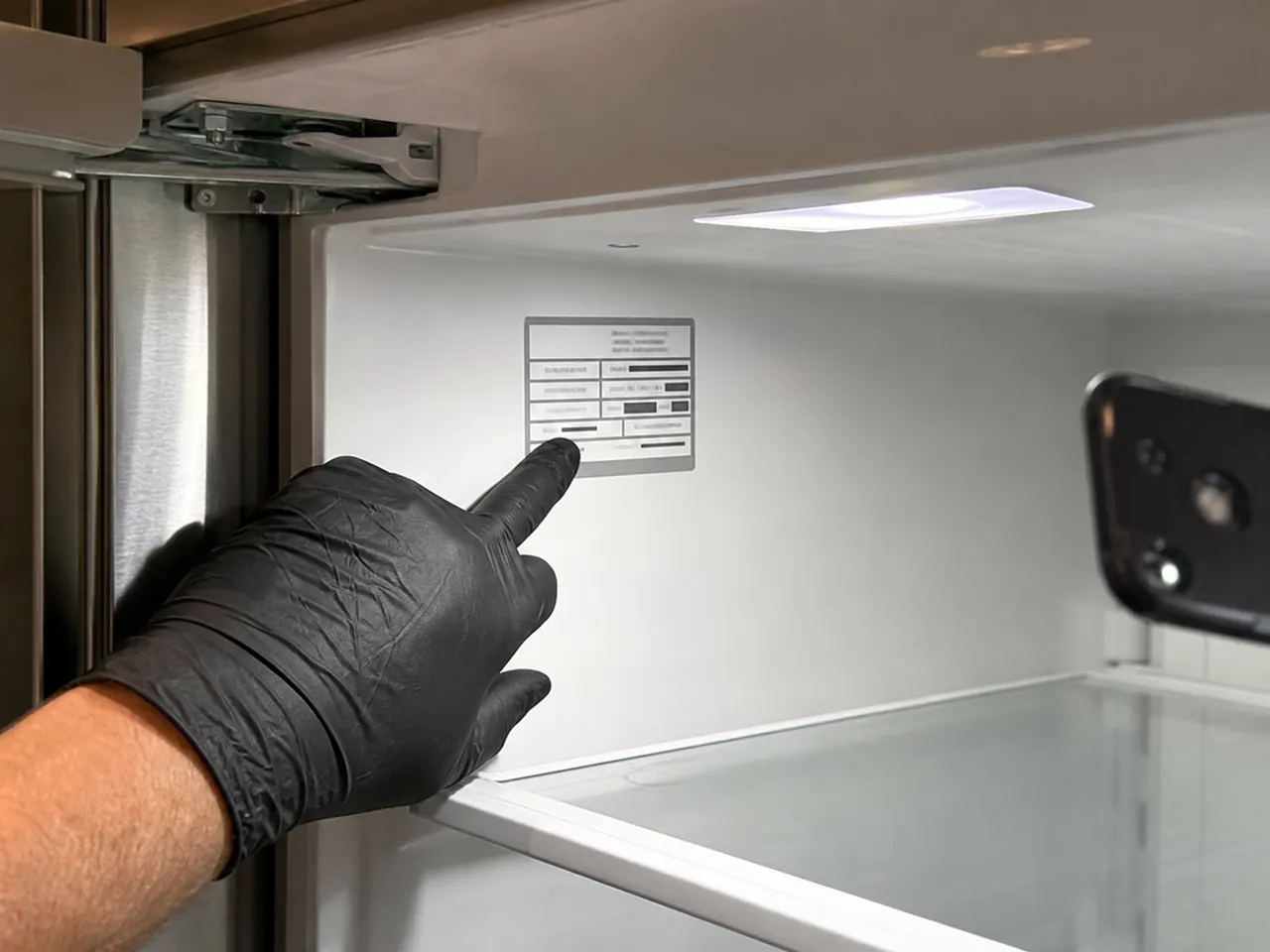
Dust-loaded condenser area being checked during built-in refrigerator diagnosis
Direct answer
Direct answers for San Leandro Sub-Zero owners
Clear, direct answers to the questions San Leandro Sub-Zero owners ask most.
Sub-Zero not cooling in San Leandro: what to check before the expensive answer
If a Sub-Zero near Casa Peralta is not cooling and you also see a door gasket leak, condensation, or a frost line, the failure path may be air infiltration rather than a dead compressor. San Leandro humidity and tight cabinetry can make a warm fresh-food section look dramatic, especially when the freezer still holds. A useful diagnosis starts with actual temperatures, condenser airflow, fan operation, gasket contact and frost pattern. That order protects you from paying for the most expensive repair before the basic evidence is in.
Model and serial details, two temperature readings, lower-grille or water-line notes, the neighborhood and a short symptom timeline should be ready before approving parts.
Diagnostic visits are $145-$225; common gasket, water-side, fan and sensor repairs often take 1-3 hours; sealed-system work requires proof and may take 2-6 hours plus parts lead time.
What San Leandro homeowners say about our Sub-Zero service
Real feedback from local Sub-Zero built-in refrigeration customers across San Leandro neighborhoods.
*****
Our Estudillo Estates-Glen Sub-Zero warmed to 48°F fresh-food overnight while the freezer stayed near 1°F. The technician tested fan response, thermistor readings and airflow, then replaced the evaporator fan. The $680 repair was done in 3 hours.
G.T., Estudillo Estates-GlenEstudillo Estates-Glen, San Leandro
*****
A Bay-O-Vista built-in showed 52°F after a hot afternoon. They checked the toe-kick, condenser fan, amp draw and door contact before calling parts. It turned out to be airflow and sensor work, $740 total, with 38°F verified before leaving.
Homeowner, Bay-O-VistaBay-O-Vista, San Leandro
*****
In Heron Bay, the freezer climbed to 16°F and ice slowed. They photographed the frost pattern, found the condenser packed with lint and corrected airflow. The $390 recovery visit took under 2 hours and avoided a sealed-system quote.
D.K., Heron BayHeron Bay, San Leandro
San Leandro evidence facts
What makes this diagnosis local
Sub-Zero not-cooling diagnostic range in San Leandro: $145-$225 for 50-95 min before any expensive branch is approved.
Fresh-food above 45°F or freezer above 15°F should be called in urgently if readings keep rising with doors closed.
A warm fresh-food side with freezer near 0°F often points to fan, baffle, sensor, air path or gasket contact before compressor failure.
Marina-side salt residue and fog cycles can load condenser fins, raising run time without proving sealed-system loss.
A useful diagnosis records independent temperatures, condenser airflow, fan response, frost pattern and cabinet access notes.
These are planning ranges only. A final quote still depends on model, part availability, cabinet access and diagnosis.
Service / symptom
What includes
Price range
Time
Warm fresh-food diagnostic
Fresh-food/freezer readings, door contact, fan response, thermistor values and airflow path.
$145-$225
50-95 min
Evaporator fan or air-baffle repair
Front-access testing, part match, fan or air-path correction and temperature retest.
$395-$1,080
1-4 hours
Condenser cleaning and fan recovery
Lower-grille cleaning, condenser fan test, amp draw check and heat-rejection verification.
$285-$640
1-2.5 hours
Control or sensor branch
Sensor readings, board output, model-family reference and alarm timeline review.
$345-$1,180
1-4 hours
Sealed-system proof before compressor quote
Frost pattern, electrical readings, pressure-side evidence and cabinet-access plan.
$1,425-$3,380
2-6 hours plus parts
Final San Leandro pricing depends most on model family, part availability, actual temperatures and cabinet access, with Heron Bay moisture and Bay-O-Vista access often changing the time window.
Diagnostic counter
Sub-Zero not cooling in San Leandro: what to check before the expensive answer evidence matrix
The first visit should separate cabinet, airflow, water-side, control and sealed-system evidence. The table gives a practical starting point, not a universal code chart.
Symptom or branch
Safe first check
Technician evidence
Urgency
Fresh-food high, freezer normal
Check evaporator fan, air baffle, door seal and thermistor values before sealed-system talk.
Actual temperatures, model tag, condenser airflow, door contact, fan response and cabinet access notes.
Same-day if paired with warming; otherwise next available diagnostic.
Both sections warm
Test condenser fan, compressor start behavior, control output and coil cleanliness.
Actual temperatures, model tag, condenser airflow, door contact, fan response and cabinet access notes.
High if food temperature is moving.
Rapid warming after reset
Read actual compartment temperature and inspect frost pattern; do not rely only on display numbers.
Actual temperatures, model tag, condenser airflow, door contact, fan response and cabinet access notes.
Same-day if paired with warming; otherwise next available diagnostic.
Same-day triage
Symptom, safe check, technician evidence and urgency
Symptom
Safe homeowner check
Technician evidence
Urgency
Frost line or condensation
Photograph the stripe and door reveal.
Gasket compression, hinge sag, drawer rail, panel weight and humidity load.
Urgent if temperatures also rise.
Slow or hollow ice
Save cube photos and note fill behavior.
Water pressure, valve, fill tube, freezer temperature and bin control.
Usually next available unless leaking.
Fan noise or cycling
Record when noise starts and whether doors change it.
Fan operation, airflow restriction, ice buildup and control signals.
Same day if paired with warming.
Error or alarm
Photograph display before reset.
Model-specific code path, actual temperature, sensor and board checks.
Same day if repeated high-temperature alarm.
Fresh-food warm, freezer OK
Keep doors closed and record both temperatures.
Evaporator fan, air path, thermistor and gasket contact.
Same day if food temperature is rising.
Both sections warm
Check lower grille is not blocked; do not clear alarms before photos.
Condenser fan, compressor start behavior, control output and frost pattern.
High priority because food safety can change quickly.
Moisture and access matrix
Neighborhood conditions that change the visit
Neighborhood
Condition
Service implication
Heron Bay / 94579
Bay-side moisture, newer integrated cabinets and slower ice recovery.
Check gasket contact, water path, freezer temperature and condenser airflow before replacing ice maker parts. For warm-cabinet diagnosis, record model family, actual temperatures and access risk before parts.
Bay-O-Vista / 94578
Hillside access, sun exposure, tight remodels and pull-out constraints.
Plan front-access diagnosis first and document floor, panel and water-line risk before moving a built-in. For warm-cabinet diagnosis, record model family, actual temperatures and access risk before parts.
Estudillo Estates-Glen / 94577
Older homes, custom openings and trim that may not tolerate rushed cabinet movement.
Confirm model tag, cabinet reveal, door swing and condenser access before quoting sealed-system work. For warm-cabinet diagnosis, record model family, actual temperatures and access risk before parts.
Broadmoor District
Older kitchen updates and built-ins fitted into painted face frames.
Separate cabinet heat and door alignment issues from refrigeration failure. For warm-cabinet diagnosis, record model family, actual temperatures and access risk before parts.
Mulford Gardens
Bay air, water-line routing and practical family kitchens with heavy door use.
Inspect gasket compression, lower grille loading and water-side restrictions. For warm-cabinet diagnosis, record model family, actual temperatures and access risk before parts.
Washington Manor-Bonaire
Busy remodels, flooring changes and panel weight on older built-ins.
Check leveling, hinge sag, drawer rail closure and safe access before parts are ordered. For warm-cabinet diagnosis, record model family, actual temperatures and access risk before parts.
Local install reality
Why San Leandro changes the repair path
Homes near San Leandro Marina and Marina Park deal with cooler bay air, salt residue, and cabinetry that may not ventilate as well after a remodel. That combination can load the condenser and keep heat trapped behind a built-in unit. Lake Chabot Regional Park is inland, but service routes from that side still bring a mix of older homes and newer kitchens where flooring changes can limit pull-out access. The diagnostic plan should name the access path, not just the suspected part.
Humidity, salt air, fog cycles, gasket swelling, condenser corrosion and tight waterfront cabinetry are not abstract here. They change which evidence matters first and whether a Sub-Zero repair can be completed from the front without disturbing the cabinet.
Model and access details are checked before parts are ordered.
Diagnostic scenarios
How common San Leandro Sub-Zero calls are handled
Typical diagnostic patterns we see on built-in Sub-Zero refrigeration across San Leandro neighborhoods.
Heron Bay / 94579 warm-cabinet diagnosis scenario
Model family: BI full-size built-in. Symptom: Fresh-food high, freezer normal. Tests: Check evaporator fan, air baffle, door seal and thermistor values before sealed-system talk. Technician evidence: Actual temperatures, model tag, condenser airflow, door contact, fan response and cabinet access notes. Outcome: Warm fresh-food diagnostic stays in the $145-$225 planning range when evidence matches. Time: 50-95 min.
Model family: integrated column. Symptom: Both sections warm. Tests: Test condenser fan, compressor start behavior, control output and coil cleanliness. Technician evidence: Actual temperatures, model tag, condenser airflow, door contact, fan response and cabinet access notes. Outcome: Evaporator fan or air-baffle repair stays in the $395-$1,080 planning range when evidence matches. Time: 1-4 hours.
Model family: 600/700 series. Symptom: Rapid warming after reset. Tests: Read actual compartment temperature and inspect frost pattern; do not rely only on display numbers. Technician evidence: Actual temperatures, model tag, condenser airflow, door contact, fan response and cabinet access notes. Outcome: Condenser cleaning and fan recovery stays in the $285-$640 planning range when evidence matches. Time: 1-2.5 hours.
Sequence
How the diagnostic visit is structured
We do not guess sealed systems, control boards or cabinet pull-outs from a headline symptom. The sequence below keeps the repair tied to proof.
1Lock in temperatures
Fresh-food and freezer readings are recorded after doors stay closed, with alarm photos captured before resets.
2Separate one-zone from two-zone failure
A warm fresh-food side with freezer holding follows a different branch than both sections warming.
3Check airflow and cabinet heat
Condenser loading, lower-grille heat, fan response and toe-kick ventilation are tested before sealed-system talk.
4Test sensors and door contact
Thermistor values, air baffle behavior, gasket compression and frost pattern are compared to the symptom.
5Quote only the proven branch
Fan, sensor, condenser, control or sealed-system pricing is assigned only after the evidence supports it.
6Verify pull-down
The visit closes with fresh-food/freezer recovery targets or a documented follow-up if parts are needed.
Before the appointment
What to have ready and what not to reset
Have the model and serial details nearby if they are requested during the call or external online booking step.
Do not reset the breaker, clear an alarm, or unplug the unit right before diagnosis unless food safety requires it; fresh readings help identify the failure path.
Clear the lower grille, toe-kick, and first two feet around the cabinet so airflow, water connections, and door alignment can be checked without scraping millwork.
Visible FAQ
Answers before you book
Should I unplug the Sub-Zero overnight?
Only do that if food safety requires it. If the unit is safe to leave running, current temperatures, fan behavior and frost pattern give better diagnostic evidence than a freshly reset cabinet.
Does a warm fresh-food side mean the compressor failed?
Not by itself. Sub-Zero systems can have fan, sensor, gasket, control, airflow or condenser problems that create the same customer symptom. Compressor or sealed-system work needs stronger proof.
What temperature readings help?
Have the displayed setpoint, the displayed actual temperature if available, and a separate thermometer reading from each section ready. Include how long the doors stayed closed before the reading.
Can this be same-day?
Often, yes, if the repair is airflow, fan, gasket, relay, sensor or cleaning related. Model-specific controls and sealed-system parts may require a follow-up once the exact model and serial are confirmed.
What should I record before a San Leandro not-cooling visit?
Record fresh-food and freezer temperatures after the doors have stayed closed at least 30 minutes, then photograph the display, model tag and lower grille. A fresh-food reading above 45°F or freezer above 15°F should be called in. Those numbers keep the diagnosis away from vague compressor guesses.
Can fog and salt air make a Sub-Zero look like it has failed?
Fog and salt-air residue can load the condenser and expose weak gaskets, especially near the Marina and Heron Bay. That can create long run times or uneven cooling without a failed compressor. A condenser recovery repair may be $285-$640; sealed-system work should wait for stronger proof.
After the proof, not before it
Call or book a cooling diagnostic
For active cooling loss, call first. For stable symptoms, use the online booking page to request a diagnostic window.