✓EPA 608 Universaltechnician-held certificationLocal focusSub-Zero built-ins in 94577, 94578 and 94579UpdatedJune 12, 2026
Chain of custody | San Leandro, Alameda County
After the recovery machine stops: where your Sub-Zero's refrigerant actually goes
When a sealed-system repair in a San Leandro kitchen is finished, the refrigerant that came out of your Sub-Zero does not vanish with the service van. It rides a documented route: the recovery machine at the kitchen counter, a labeled cylinder on the truck, consolidation at the shop, an EPA-certified reclaimer, and finally re-refinement to specification or destruction. The journey out of your kitchen is mapped by Clean Air Act Section 608, whose refrigerant provisions EPA codified at 40 CFR Part 82, Subpart F. This page walks that route, station by station, the way our counter log records it.
The route starts here: the compressor side opened, the recovery machine connected, the charge drawn down before any circuit work.
Direct answer
Direct answers about the recovered charge
Three short answers before the longer walk along the route.
Recovery is inside the repair, not an extra line
If a San Leandro sealed-system job opens the refrigerant circuit, recovering the charge is simply part of lawful service. It is not an option you select at booking, and it does not arrive later as a surprise. The published planning ranges for sealed-system work already assume the recovery machine runs.
No charge leaves a cabinet on a hunch. The recovery machine is connected only after temperatures, condenser airflow, electrical readings and frost pattern have proven the sealed-system branch - the same evidence order we hold compressor quotes to.
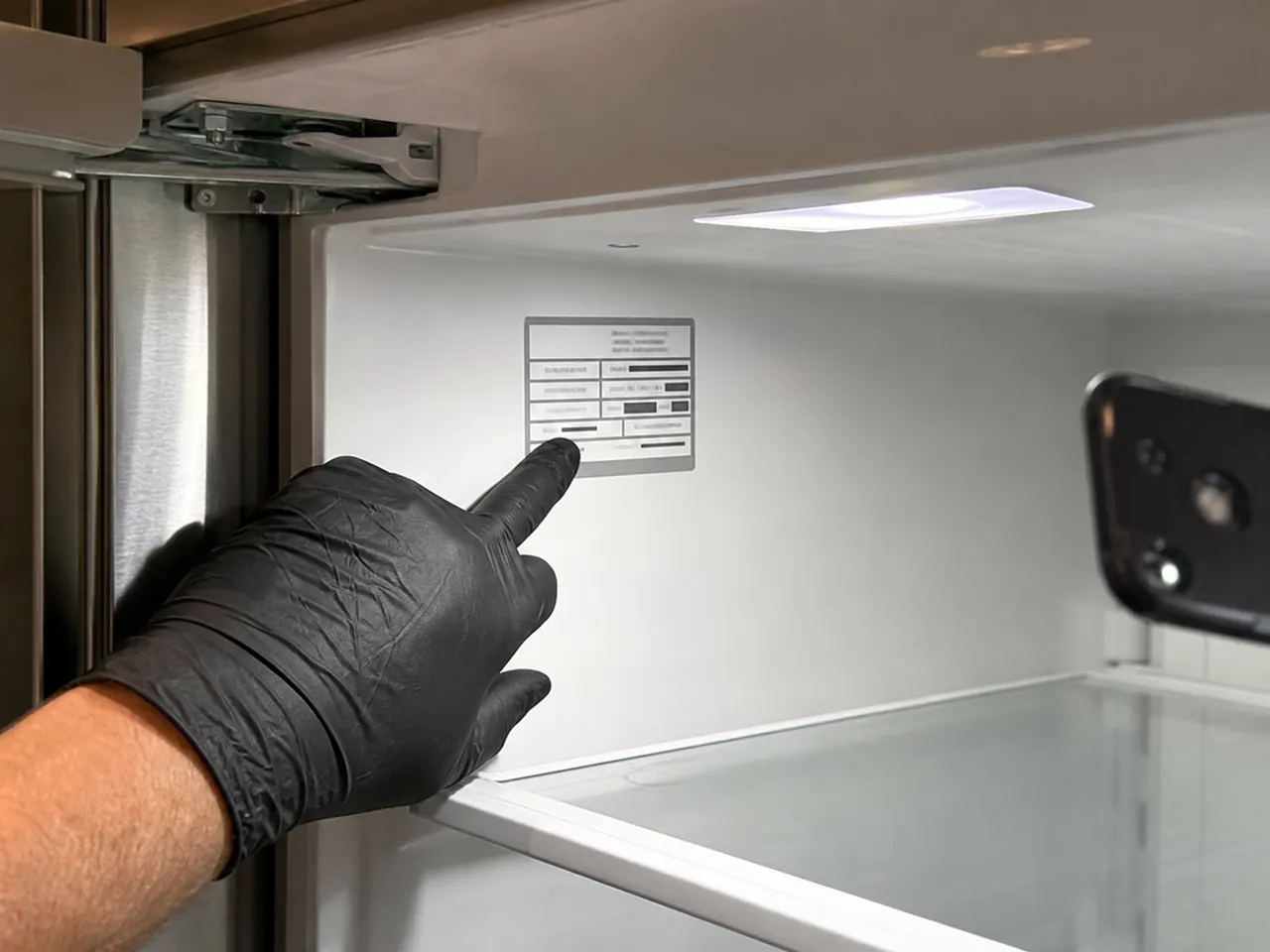
A 1989 cabinet, a 2005 built-in and a 2023 column do not surrender the same refrigerant. The model and serial tag tells the technician what the recovery cylinder will hold before the van leaves Marina Blvd.
Five stations between your kitchen and the end of the route
The walk-through below follows one charge out of a built-in. The chain begins with a rule dated November 14, 1994: only a certified technician may take the charge out in the first place. Everything downstream inherits that starting point.
1The recovery machine at the kitchen counter
Once the sealed-system diagnosis is proven, the technician connects a recovery machine and draws the charge into a service cylinder before any brazing or component work begins. In a tight Estudillo Estates-Glen kitchen the machine usually sits on a protected counter or floor mat, and the cabinet itself never has to leave its opening for this step.
2The labeled cylinder on the truck
The gas rides out of the house in a dedicated recovery cylinder marked with what it holds and which job it came from. Mixed gases are a reclaimer's headache, so a cylinder that took R-134a from a Washington Manor kitchen is not topped up with something different on the next call.
3Consolidation at the shop
Cylinders from San Leandro jobs are consolidated by gas type and held until a batch is worth shipping. The counter log notes the job, the gas, the weight recovered and the weight shipped - a running tally any owner is welcome to ask about.
4The EPA-certified reclaimer
Full cylinders are consigned to an EPA-certified reclaimer: a listed facility, not simply whoever owns a larger tank. From that hand-off the gas is the reclaimer's responsibility, and the consignment receipt closes our side of the chain.
5Re-refinement to specification, or destruction
At the reclaimer the batch is analyzed. Gas that can be brought back to purity specification is re-refined and returns to lawful circulation; gas that is too contaminated or too blended is destroyed. Either way the route ends somewhere accountable - never in the open air over the bay.
Route rules
Five rules that govern every station
Nothing on this route escapes to the sky: the venting prohibition has covered CFC and HCFC refrigerants ever since July 1, 1992, and substitutes - your R-134a - since November 15, 1995. The trace amounts that slip out during good-faith recovery are tolerated by the rule; opening a circuit to the air is not.
Who may start the journey matters: Type I certification covers small appliances - refrigerant charged and sealed at the plant, five pounds the upper bound, household refrigerators within scope - while Type II, Type III and the supervised Core round out a Universal rating. Our technicians carry the Universal rating.
At every station along this route, the authority is personal: a certificate naming one technician, valid without any terminal date. The signature follows the person, not the van they drove that day.
The chain runs backward, too: the replacement gas that eventually enters a repaired system was itself sold under the certified-buyers-only rule for stationary equipment. Supply and disposal are certified-gated ends of the same route.
Every signature along this chain of custody is a person's - fittingly, since Section 608 certification is conferred on individuals, never on firms. When we say the work is certified, we mean the technicians who sign, not the letterhead.
Chain of custody
What the record shows at each station
A recovered charge is only as traceable as the notes that travel with it. This is the practical shape of the log, station by station.
Station
What happens there
What is recorded
Kitchen counter
Charge recovered into a service cylinder after the sealed-system branch is proven.
Job reference, model family, gas type and recovered weight.
Truck
Labeled cylinder secured for transport; contents never blended between calls.
Cylinder identity, contents and the job it came from.
Shop
Cylinders consolidated by gas type and staged for shipment.
Running weights in and out against each job reference.
Certified reclaimer
Batch consigned to an EPA-certified reclamation facility.
Consignment receipt, facility and date of hand-off.
End of route
Re-refinement to purity specification, or destruction when the batch cannot be saved.
The reclaimer's disposition of the batch.
The record exists so that a charge recovered beside a Heron Bay counter can be accounted for months later without anyone relying on memory.
Model eras
What ends up in the cylinder
What ends up in the cylinder depends on what was in the kitchen: R-12 out of pre-1994 cabinets, R-134a out of the 1994-model-year-and-later majority (less certain PRO models), R-600a out of refrigeration introduced after January 2021. Three eras, three different entries in the log, one route.
R-600a takes a quieter branch of the route: exempted by EPA from the household venting prohibition, it is collected all the same - a flammable gas earns cautious transport. Some newer columns fall into that post-2021 group, which is one more reason wine storage temperature drift in San Leandro gets a model check before anyone considers touching the circuit.
The model and serial tag names the era - and the era names the gas.
Bay-air reality
Why a marina city keeps a tighter log
Salt air off the marina and fog cycles over 94579 are hard on condenser fins, so San Leandro produces more warm-cabinet calls than an inland ZIP of the same size. Most of those calls never reach the recovery machine: the San Leandro not-cooling diagnostic order catches loaded coils, weak fans and tired gaskets long before anyone discusses the sealed system.
When a call does reach the recovery stage, waterfront kitchens raise the stakes. A built-in behind Heron Bay cabinetry or older Estudillo trim is not a unit anyone wants to open twice, so the charge comes out once, into one cylinder, with the notes written at the counter while the machine is still running.
The same bay conditions argue for the route itself. A city that lives this close to the water has an obvious interest in refrigerant that travels in cylinders and ends at a certified facility, and our log is built so that every charge recovered here can be shown to have done exactly that.
Is recovered refrigerant reused in other machines?
Sometimes, but only after an EPA-certified reclaimer brings it back to specification. Recovered gas that analyzes clean enough is re-refined and can lawfully return to circulation in other equipment; charges that are too contaminated or too blended are routed to destruction instead. Which fork a cylinder takes is decided by laboratory analysis at the reclaimer, not by anyone standing in your kitchen.
Do I pay extra to have the refrigerant recovered?
No. Recovery is not an option you approve separately - it is simply what lawful sealed-system service is. If a San Leandro repair opens the refrigerant circuit, running the recovery machine is part of the job in the same way that reconnecting the water line is. You will not see it offered as an upgrade, because leaving it out was never on the menu.
What happens to the refrigerant when an old Sub-Zero is hauled away?
Disposal does not skip the route. Before a refrigerator is scrapped or recycled, the remaining charge has to come out through the same certified hands - recovered into a cylinder, consolidated, consigned to a reclaimer - that a repair charge passes through. If you are weighing disposal against repair, ask whoever hauls the unit who recovers the charge and where it is consigned; a good answer names a person and a facility.
After the proof, not before it
Book a San Leandro diagnostic window
For active cooling loss, call first. For stable symptoms, use the online booking page to request a diagnostic window. Recovery, when the evidence calls for it, is already part of the visit.