★5.0 ratingSan Leandro Sub-Zero customersLocal focusSub-Zero built-ins in 94577, 94578 and 94579IndependentSub-Zero & Wolf specialists since 2005
Symptom | San Leandro, Alameda County
Sub-Zero freezer not freezing in San Leandro: read the frost before you panic
When a Sub-Zero freezer in San Leandro stops holding 0°F, the cause is far more often a tired defrost part or a blocked drain than a dead compressor. A freezer that drifts up to 15-25°F, grows a sheet of frost across the back wall, or lets ice cream go soft usually points to the defrost heater, the defrost thermostat, a clogged defrost drain, or a stalled evaporator fan. This page walks San Leandro owners through how the freezer is supposed to work and which low-cost faults to rule out first.
A built-in Sub-Zero does not freeze the way a basic top-mount refrigerator does. Most BI, IT and IC columns run two separate sealed systems — one for the fresh-food side and one for the freezer — so the freezer can hold a steady 0°F without borrowing cold from the refrigerator. A small evaporator coil behind the back panel does the actual freezing, an evaporator fan pushes that cold across the food, and on a timed cycle a defrost heater briefly warms the coil so frost melts and drains away. Weaken any link in that chain and the freezer slowly loses its grip on zero.
In San Leandro that chain gets leaned on harder than it would a few miles inland. The marine layer that slides over the Marina and the Bay Trail most mornings carries damp, salt-tinged air, and every time a door opens in a flatland kitchen off East 14th some of that moisture rides in. More moisture means more frost for the defrost cycle to clear, so a heater or drain that is only slightly weak shows itself sooner here than it would in a dry inland house.
Likely causes, cheapest first
What actually stops a Sub-Zero freezer from freezing
Defrost heater that no longer clears the coil
A failed defrost heater is the classic story of a freezer slowly warming under heavy back-wall frost. The coil ices over, the evaporator fan can no longer push air through it, and the compartment climbs toward 20°F even while the compressor runs almost non-stop. It is one of the more affordable sealed-cabinet repairs and is worth ruling out long before anyone names the compressor.
Stuck defrost thermostat (bimetal)
The defrost thermostat decides when the coil is cold enough to need a defrost and when the heater should switch off. When it sticks, the heater either never fires or never stops. The frost pattern on the rear panel is the giveaway, and the bimetal itself is a small, inexpensive part.
Clogged or frozen defrost drain
Melt water from each defrost is meant to run down a narrow drain and evaporate off the condenser pan. In damp San Leandro kitchens that line is the first thing to clog with sludge or freeze shut, so the water refreezes at the bottom of the freezer as a growing slab of ice. Once it overflows you also get the puddle covered on our water-leaking page.
Stalled or worn evaporator fan
If the freezer is cold right at the coil but warm out near the door, a stalled or noisy evaporator fan is a strong suspect. Fan-motor bearings are one of the parts that the salt-damp bay air wears out faster on flatland units close to the water.
Relaxed door or drawer gasket
A tired freezer-drawer or door gasket lets humid room air leak straight in, which both raises the temperature and feeds the frost problem. The paper-slip test around the seal is a two-minute check anyone can do.
The sealed system — checked last
Only after the defrost parts, the fan and the gasket all check out does a sealed-system fault — a refrigerant leak or a weak compressor — become the likely answer. That diagnosis needs frost-pattern, electrical and pressure evidence, never a guess.
Before you call
Check your San Leandro freezer in five steps
1Confirm the setpoint and give it a day
Make sure the freezer is set near 0°F and was not nudged during a grocery load. After a big door-open session or a power blip, a healthy unit can take a full 24 hours to pull back down.
2Listen for the evaporator fan
With the freezer open, hold the door switch in and listen. A steady whir behind the back panel is good; silence, or a grinding and clicking, points to the fan or to ice locking the blade.
3Clear the air path
Move boxed food away from the back-wall vents. Packed-in food in a busy Heron Bay family freezer can block the very airflow that keeps the door end of the compartment cold.
4Read the frost pattern
A uniform light frost is normal. A thick solid sheet of ice on the back wall says defrost; bare patches next to warm spots say airflow or fan. Photograph it before you thaw anything so the technician can see it.
5Test the gasket
Close the door on a slip of paper and pull. If it slides out with no drag anywhere along the seal, the gasket is letting San Leandro's damp air in and should be checked.
Why the bayside flatland matters
San Leandro humidity loads the defrost cycle
A Sub-Zero in a dry Livermore or Pleasanton kitchen might run for years before a marginal defrost drain or a tired heater becomes obvious. On the San Leandro flatland — Estudillo Estates-Glen, Broadmoor, and the blocks near Farrelly Pond and Marina Faire — the extra moisture loads the defrost cycle every single day.
Older Bay-O-Vista and Estudillo kitchens running original-era defrost parts tend to be the ones we find first with a freezer that "used to be fine." It is rarely the catastrophe owners fear; it is usually a small part doing its job under a heavier moisture load than the factory ever tested for in a dry climate.
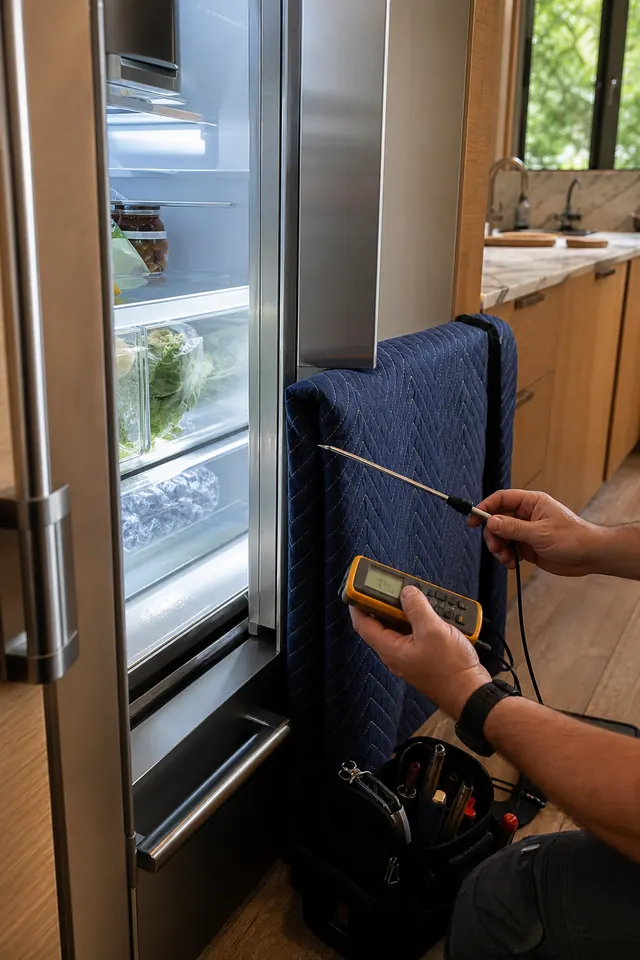
Defrost and airflow evidence is read before any sealed-system talk.
Visible FAQ
Freezer-not-freezing questions
My Sub-Zero freezer is at 20°F but the refrigerator is fine — is that normal?
On a dual-system built-in the two sides run independently, so a warm freezer with a cold refrigerator is common and usually points to a freezer-specific fault: defrost, evaporator fan, or that side's sealed system. It does not mean the whole unit is failing.
There is a sheet of ice on the back wall of my freezer. What is it?
That is the defrost system failing to clear frost — most often a defrost heater or thermostat, sometimes a clogged drain. Melting it by hand buys a day or two, but the frost returns until the defrost part is replaced.
Should I unplug and defrost it myself first?
You can, and it will temporarily restore cooling, but it also erases the evidence. If you can, photograph the frost pattern and note the temperatures first, then defrost only if food safety requires it.
How fast can you come out in San Leandro?
For a freezer climbing with food at risk we prioritize same-day across 94577, 94578 and 94579. For a stable, slow-warming freezer, a booked window works fine.
Is a warming freezer ever the sealed system?
Yes, but it is the last branch, not the first. We confirm the defrost parts, fan and gasket before any sealed-system or compressor conversation, which keeps you from paying for the most expensive repair on a guess.
San Leandro Sub-Zero Repair is an independent appliance repair company. We are not affiliated with, authorized by, or endorsed by Sub-Zero Group, Inc.; the Sub-Zero name is used only to describe the appliances we service.